Key points
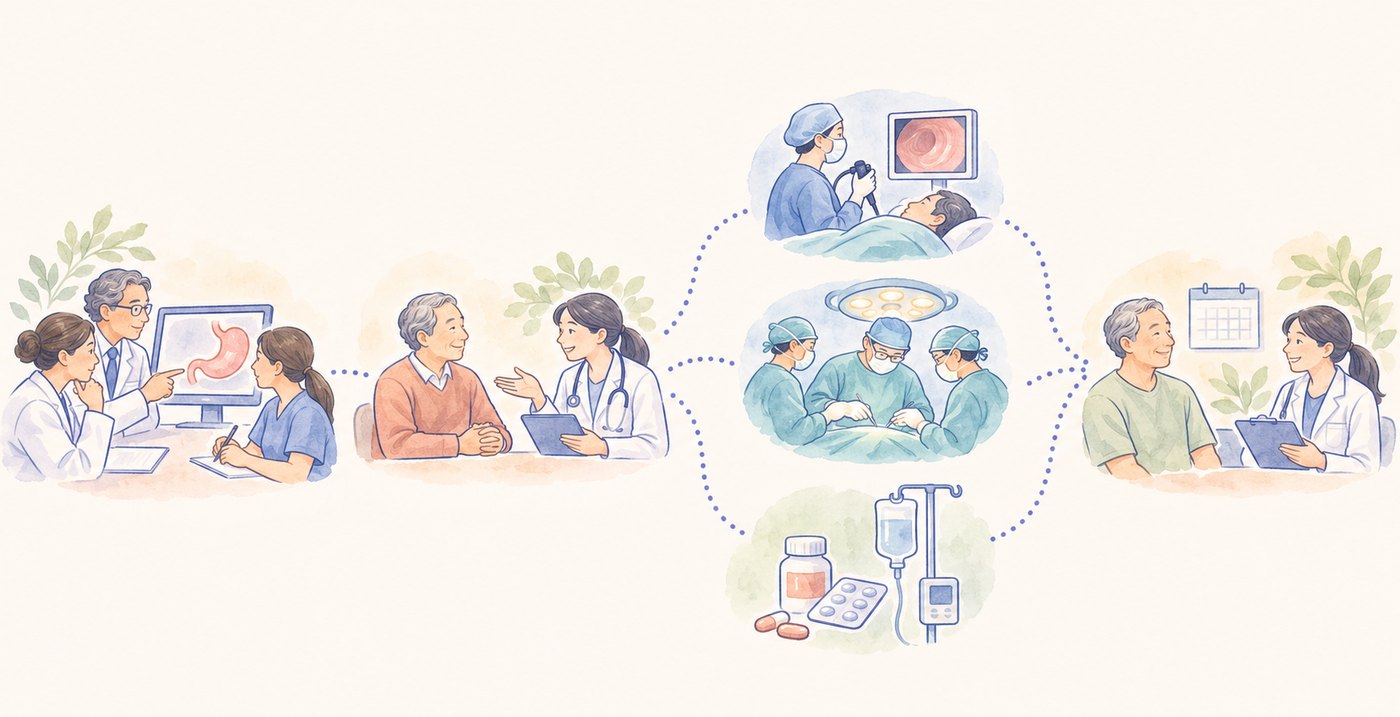
- There is no single treatment for everyone. The plan depends on the stage, the biomarkers, your general health and what matters to you.
- A team of specialists usually plans treatment together.
- Very early cancers can sometimes be removed through an endoscope, with no cuts on the tummy.
- Many people have chemotherapy before and after surgery.
- If the cancer has spread, medicines are the main treatment. They aim to control the cancer and help you feel better for longer.
Who is on the stomach cancer treatment team?
A surgeon, a cancer medicine doctor (oncologist), a stomach and gut doctor (gastroenterologist), a scan doctor (radiologist), a pathologist, a dietitian, specialist nurses and a palliative care team. They often meet to discuss each person's plan. This is called a multidisciplinary team (MDT) meeting.
How is stomach cancer treated at each stage?
- Very early cancer, only in the top liningRemoval through an endoscope may be possible
- Early cancer that is not suitable for endoscopic removalSurgery
- Cancer that has grown deeper or reached nearby lymph nodes, but can be removedChemotherapy, then surgery, then more chemotherapy. An immune medicine may be added
- Cancer that has spread to other parts of the bodyMedicines chosen by biomarkers, plus care to control symptoms
Can early stomach cancer be removed without an operation?
For some very early cancers, the doctor can shave the tumour off the stomach lining using tools passed through an endoscope. There are two methods, called EMR and ESD. The stomach stays in place. The removed piece is checked under the microscope to make sure the cancer is fully out. If it is not, surgery may still be advised.
Surgery for stomach cancer
Surgery removes part or all of the stomach together with nearby lymph nodes. See the Surgery and recovery page.
Chemotherapy for stomach cancer
Chemotherapy uses medicines that kill fast-growing cells. It is usually given through a drip, in cycles, with rest weeks in between. Side effects differ between medicines and between people. Common ones are tiredness, feeling sick, loose stools, a sore mouth, numb or tingling fingers, and a higher chance of infections. Your team will give medicines to prevent or ease many of these.
Why before and after surgery? Chemotherapy before surgery can shrink the tumour and treat cancer cells too small to see. Chemotherapy after surgery aims to lower the chance of the cancer coming back.
Want more detail? (Treatment around surgery)
- The usual chemotherapy around surgery is a four-medicine combination called FLOT (fluorouracil, leucovorin, oxaliplatin, docetaxel). In the German FLOT4 trial of 716 people, those given FLOT lived longer than those given the older combination (median 50 months versus 35 months)25.
- In the MATTERHORN trial of 948 people, adding the immunotherapy durvalumab to FLOT improved survival. See the Latest evidence page26, 27.
- Guidelines in Europe and Japan differ in some details. In East Asia, surgery followed by chemotherapy is also a standard approach13, 14.
What is targeted therapy?
Targeted medicines lock on to a specific feature of the cancer cell, like a key fitting a lock. They only work if the cancer has that feature. This is why biomarker tests matter.
What is immunotherapy?
Your immune system is your body's defence force. Some cancers switch on a "do not attack" signal to hide from it. Immunotherapy medicines block that signal so the immune system can see the cancer again. Side effects happen when the immune system also irritates healthy parts of the body, such as the skin, gut, lungs or hormone glands. Tell your team about any new symptom.
Want more detail? (Medicines for cancer that has spread)
| Biomarker result | What may be added to chemotherapy | Key evidence |
|---|---|---|
| HER2-positive | Trastuzumab, a HER2-targeting antibody. Pembrolizumab, an immunotherapy, may be added when PD-L1 is also positive | ToGA: median survival 13.8 versus 11.1 months18. KEYNOTE-811: longer time before the cancer grew19 |
| HER2-negative, PD-L1 positive | Nivolumab or pembrolizumab (immunotherapy) | CheckMate 649: at five years, 16% versus 6% of people with PD-L1 CPS 5 or more were alive20. KEYNOTE-859: median survival 12.9 versus 11.5 months21 |
| HER2-negative, claudin 18.2 positive | Zolbetuximab, a claudin-targeting antibody | SPOTLIGHT and GLOW: longer survival than chemotherapy alone; more nausea and vomiting23, 24 |
| MSI-H or dMMR | Immunotherapy is especially active | Pooled analysis of three trials22 |
| HER2-positive, after first treatment stops working | Trastuzumab deruxtecan, an antibody that carries chemotherapy to HER2 cells | DESTINY-Gastric04: median survival 14.7 versus 11.4 months. Lung inflammation is a known risk29 |
Which medicines are registered, available and funded differs from country to country. A qualified cancer specialist can advise on what applies in Malaysia.
Is radiotherapy used for stomach cancer?
Radiotherapy uses high-energy rays. In stomach cancer it is used in selected situations, for example to control bleeding or pain.
What is supportive and palliative care?
Palliative care is extra support to control symptoms such as pain, sickness and poor appetite, and to support you and your family. It can be given alongside cancer treatment at any stage. It does not mean giving up.
What is a clinical trial?
A clinical trial tests whether a new treatment is safe and works better than the current one. You can ask your doctor whether a trial is suitable for you.
Common questions
What is the difference between chemotherapy, targeted therapy and immunotherapy?
Chemotherapy attacks fast-growing cells. Targeted therapy locks on to a specific feature of the cancer cell. Immunotherapy helps your own immune system find the cancer.
Can stomach cancer be cured?
When found early, it can often be treated with the aim of cure. The chance depends mainly on the stage.
Should I take supplements or traditional medicine during treatment?
Tell your cancer team about everything you take. Some products interfere with treatment.
References
- Al-Batran SE, et al. Gastric and oesophageal cancer: ESMO Clinical Practice Guideline for diagnosis, treatment and follow-up. Ann Oncol 2026 (published online October 2026). doi:10.1016/j.annonc.2026.09.015
- Japanese Gastric Cancer Association. Japanese gastric cancer treatment guidelines 2025 (7th edition). Gastric Cancer 2026;29(2):271–299. doi:10.1007/s10120-025-01698-4
- Bang YJ, et al. Trastuzumab in combination with chemotherapy versus chemotherapy alone for treatment of HER2-positive advanced gastric or gastro-oesophageal junction cancer (ToGA). Lancet 2010;376(9742):687–697. doi:10.1016/S0140-6736(10)61121-X
- Janjigian YY, et al. Pembrolizumab plus trastuzumab and chemotherapy for HER2-positive gastric or gastro-oesophageal junction adenocarcinoma: interim analyses from the phase 3 KEYNOTE-811 trial. Lancet 2023;402(10418):2197–2208. doi:10.1016/S0140-6736(23)02033-0
- Janjigian YY, et al. Nivolumab plus chemotherapy as first-line treatment for advanced gastric, gastroesophageal junction, and esophageal adenocarcinoma: 5-year follow-up results from CheckMate 649. Ann Oncol 2026;37(6):787–797. doi:10.1016/j.annonc.2026.02.003
- Rha SY, et al. Pembrolizumab plus chemotherapy versus placebo plus chemotherapy for HER2-negative advanced gastric cancer (KEYNOTE-859). Lancet Oncol 2023;24(11):1181–1195. doi:10.1016/S1470-2045(23)00515-6
- Chao J, et al. Assessment of pembrolizumab therapy for the treatment of microsatellite instability-high gastric or gastroesophageal junction cancer among patients in the KEYNOTE-059, KEYNOTE-061, and KEYNOTE-062 clinical trials. JAMA Oncol 2021;7(6):895–902. doi:10.1001/jamaoncol.2021.0275
- Shitara K, et al. Zolbetuximab plus mFOLFOX6 in patients with CLDN18.2-positive, HER2-negative, untreated, locally advanced unresectable or metastatic gastric or gastro-oesophageal junction adenocarcinoma (SPOTLIGHT). Lancet 2023;401(10389):1655–1668. doi:10.1016/S0140-6736(23)00620-7
- Shah MA, et al. Zolbetuximab plus CAPOX in CLDN18.2-positive gastric or gastroesophageal junction adenocarcinoma: the randomized, phase 3 GLOW trial. Nat Med 2023;29(8):2133–2141. doi:10.1038/s41591-023-02465-7
- Al-Batran SE, et al. Perioperative chemotherapy with fluorouracil plus leucovorin, oxaliplatin, and docetaxel versus fluorouracil or capecitabine plus cisplatin and epirubicin for locally advanced, resectable gastric or gastro-oesophageal junction adenocarcinoma (FLOT4). Lancet 2019;393(10184):1948–1957. doi:10.1016/S0140-6736(18)32557-1
- Janjigian YY, et al. Perioperative durvalumab in gastric and gastroesophageal junction cancer. N Engl J Med 2025;393(3):217–230. doi:10.1056/NEJMoa2503701
- Janjigian YY, et al. Perioperative durvalumab plus fluorouracil, leucovorin, oxaliplatin, and docetaxel for resectable gastric and gastro-oesophageal junction adenocarcinoma (MATTERHORN): final results of overall survival and event-free survival by pathological response. Lancet 2026;408(10560):1114–1128. doi:10.1016/S0140-6736(26)01254-7
- Shitara K, et al. Trastuzumab deruxtecan or ramucirumab plus paclitaxel in gastric cancer (DESTINY-Gastric04). N Engl J Med 2025;393(4):336–348. doi:10.1056/NEJMoa2503119
For general education only. Not a substitute for consultation with a qualified doctor. Not a diagnosis or treatment advice.
If you have urgent symptoms such as vomiting blood, black tarry stools, severe tummy pain, fainting or difficulty breathing, go to the nearest emergency department or call 999.